
-
 by Certified Arborist
 - 23 Apr 2026
- Views: 12
South American Palm Weevil Treatment: A Complete Guide for San Diego Homeowners and Beyond
If you have a Canary Island date palm in your yard and you live in San Diego — or anywhere in Southern California — there is a very real chance it is already under threat. The South American palm weevil has killed more than 20,000 palms across San Diego County alone, and that number keeps climbing every year. This guide covers everything you need to know: what this pest is, how to spot it early, and most importantly, what South American palm weevil treatment actually looks like in the real world.
What Exactly Is the South American Palm Weevil?
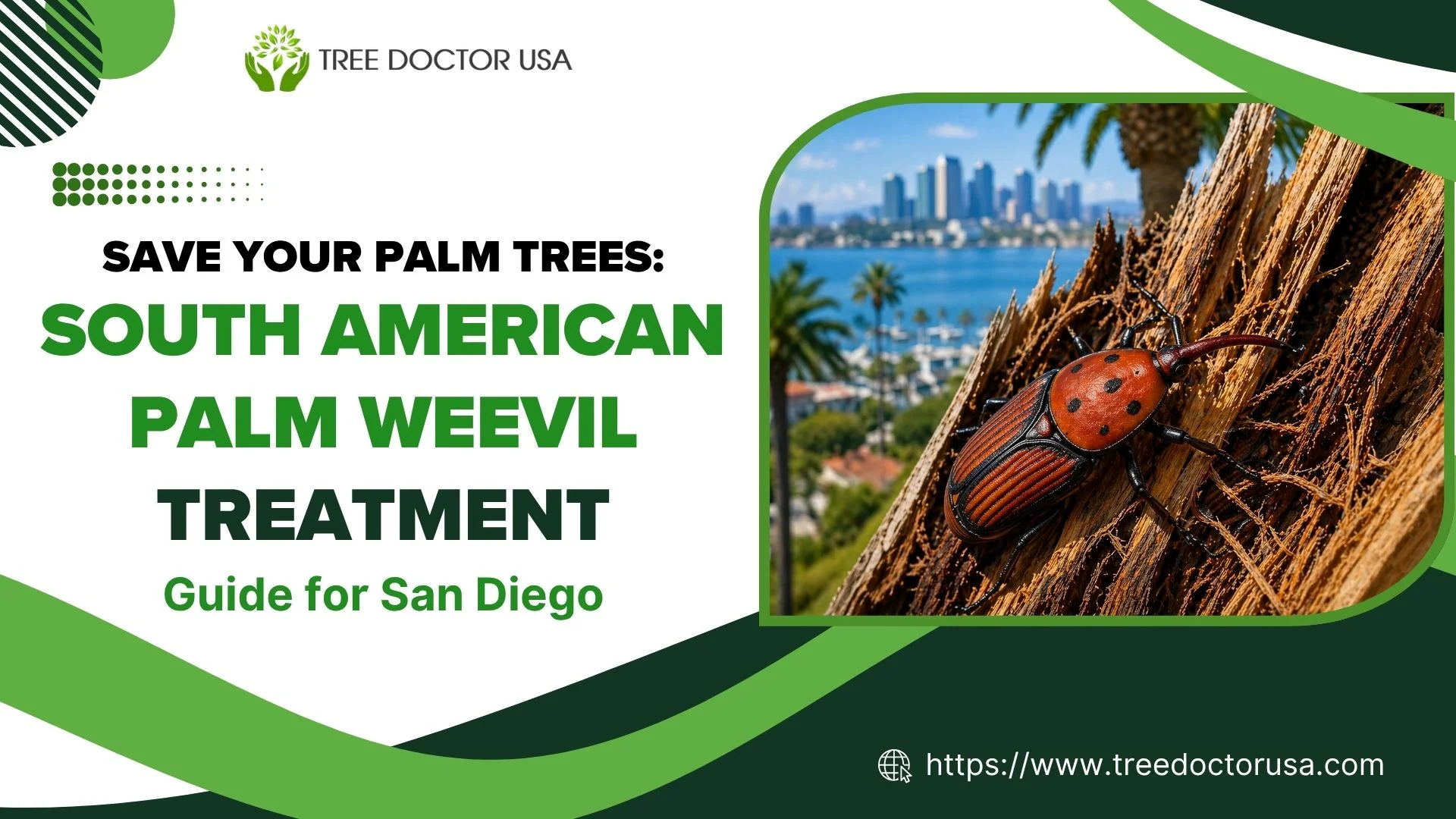
The South American palm weevil (Rhynchophorus palmarum) is a large, black snout beetle. It is native to parts of Mexico, Central America, South America, and the Caribbean, but it has become one of the most destructive invasive pests in California’s history.
Adults are strong fliers. They can cover long distances in a single day, which is a big part of why this pest has spread so fast across San Diego neighborhoods and even into the Coachella Valley, where commercial date farms are now on high alert.
The female weevil uses her elongated snout to drill into the crown of a palm tree and lay eggs inside the soft, living tissue. Once those eggs hatch, the larvae go to work. They tunnel straight through the apical meristem — the single growing point at the heart of every palm. And here is the brutal part: palms only have one growing point. Once it is destroyed, the tree is dead. There is no growing back from that.
South American Palm Weevil in San Diego: How Bad Is It Really?
The South American palm weevil was first detected near the Tijuana–San Diego border around 2011. By 2015, it was confirmed to be killing palms in San Ysidro. Since then, it has spread northward into dozens of neighborhoods across the county.
UC ANR researchers tracked 521 palms in and around Bonita, California. Over roughly 6.5 years, more than 70% of those trees were killed by SAPW. That is not a pest problem. That is a crisis.
Beyond Bonita, infestations have been documented in Balboa Park and communities stretching across the greater San Diego area. Adults have been trapped as far north as the Coachella Valley, which is why the commercial date industry there is watching this situation closely.
Removal costs for large Canary Island date palms typically run between $2,400 and $4,000 per tree, and in difficult access situations, costs can reach $15,000. That alone tells you how serious getting ahead of South American palm weevil treatment needs to be.
Which Palms Are Most at Risk?
While South American palm weevils can attack many species, their most preferred target in Southern California is the Canary Island date palm (Phoenix canariensis). Those are the big, dramatic palms you see lining streets and filling parks all over San Diego.
Other vulnerable species include:
- Date palm (Phoenix dactylifera)
- Coconut palm (Cocos nucifera)
- True sago palm (Metroxylon sagu)
If you have a Canary Island date palm on your property, or near it, you need to be paying attention to palm weevil control actively — not reactively.
How to Recognize the Problem Before It’s Too Late
This is where most homeowners lose the battle. By the time you can clearly see that something is wrong, the damage inside the tree is often already severe. That is what makes early detection so critical in any South American palm weevil treatment program.
Here are the signs to look for, starting with the earliest:
Early warning signs:
- Yellowing that starts in the newest, uppermost fronds (not the old ones at the bottom)
- A slight flattening or depression at the top of the crown
- Small round holes at the base of fronds
- Sawdust-like material (frass) is collecting in the crown
More advanced signs:
- Missing or collapsed spear leaves (the new, upright growth at the very top)
- A foul, fermented smell coming from the crown
- Pupal cases — papery cocoons made from palm fibers — visible on the ground or in crown debris
- Crown tilting or partial collapse while lower fronds still look green
That last point trips people up. A palm can look mostly fine from the street, while the heart of it is already destroyed internally. Do not wait for the whole tree to brown out.
South American Palm Weevil vs. Palm Diseases: Getting the Diagnosis Right
Here is something worth knowing: not every dying Canary Island date palm in San Diego is being killed by South American palm weevil. Local arborists point to three main causes of the current wave of palm deaths in the county — SAPW, Fusarium wilt, and poor maintenance practices. Often, two or all three are happening to the same tree.
Fusarium wilt is a fungal disease caused by Fusarium oxysporum f. sp. canariensis. It tends to cause slower, one-sided browning that works its way through the canopy progressively. Dead fronds often stay attached to the trunk rather than collapsing. It spreads almost entirely through contaminated pruning tools and infected debris.
SAPW tends to move faster. Crown collapse, missing spear leaves, frass, and tunneling near the crown are more typical of weevil damage. But symptoms can genuinely overlap, which is why professional diagnosis matters.
Getting this wrong is expensive. If you treat weevils aggressively for weevils when the tree actually has Fusarium wilt, you have wasted money and time — and potentially spread the fungal disease with unsterilized equipment in the process.
If your palm is showing rapid crown changes, wilting, or structural instability, get a qualified arborist out to look at it before deciding on a treatment path.
South American Palm Weevil Treatment: What Actually Works
Let’s get into the core of what you came here for. Based on University of California research and field trials in San Diego, here is what effective South American palm weevil treatment looks like.
The Core Principle: You Need a Layered Approach
UC ANR is clear on this point. The most effective South American palm weevil treatment combines crown spraying with systemic soil treatment. Neither approach on its own provides the same level of protection as both together.
1. Crown Sprays
Crown sprays target adult weevils and any early-stage larvae near the surface of the crown. The insecticides most recommended by UC research for this application include:
- Bifenthrin (a pyrethroid)
- Imidacloprid (a neonicotinoid)
- Dinotefuran (a neonicotinoid)
These are applied directly to the center meristem area and the upper crown. Because of the height of mature Canary Island date palms and the drift risk involved, these applications should always be done by a licensed professional with proper equipment.
2. Systemic Soil Drenches
Soil drenches deliver insecticide into the root zone, where it gets taken up by the tree and translocated upward into new frond growth. This creates internal protection in the very tissue that SAPW larvae need to feed on.
UC ANR recommends a mixture dominated by imidacloprid and dinotefuran for soil drench applications. These treatments need to be repeated — typically three to four times per year — because there is no lasting residue that carries indefinitely. As long as South American palm weevil pressure remains high in your area, your palms need ongoing treatment.
3. Trunk and Basal Sprays
Dinotefuran, combined with a bark-penetrating adjuvant like Pentra-Bark, can be applied directly to the trunk. This gets the insecticide into the tree faster than soil drenches, but the protection is shorter-lived — roughly two to three months per application.
4. Trunk Injections: The Strongest Option for High-Value Trees
This is where the most recent research is pointing. A field study conducted at Balboa Park in San Diego between 2020 and 2022 evaluated multiple treatment approaches on mature Canary Island date palms under real, heavy SAPW pressure.
The results were striking. Palms receiving trunk injections of emamectin benzoate (sold as Mectinite) consistently maintained near-healthy canopies throughout the two-year trial. Palms receiving only soil injections of imidacloprid and dinotefuran showed canopy decline scores that were similar to — or in some cases worse than — untreated control trees.
This does not mean soil treatments are worthless. It means that for high-value trees in high-pressure areas, trunk injections should be in your South American palm weevil treatment plan.
Why Insecticidal Soap Will Not Help Here
This comes up often enough that it is worth addressing directly. Insecticidal soap is not an effective palm weevil control tool. Not for South American palm weevils. Not for palmetto weevils. Not for any internal crown-boring weevil.
Insecticidal soaps are potassium fatty acid salts. They work by direct contact with soft-bodied insects — aphids, spider mites, whiteflies and mealybugs. They have zero systemic activity. Once the spray dries, it does nothing. And it absolutely cannot reach larvae tunneling deep inside a palm crown.
Insecticidal soap for palm trees does have a place — if you have aphids or scale on your palm fronds, soap sprays can manage those. But as a weevil spray? It is the wrong tool entirely, and using it while SAPW larvae feed inside your tree’s crown means losing the tree while feeling like you did something about it.
Palm Weevil Treatment Step-by-Step: What a Professional Program Looks Like
If you hire a qualified arborist or pest control company for palm weevil treatment in San Diego, here is roughly what that process involves:
Step 1 — Inspection and diagnosis. A certified arborist examines the palm for SAPW symptoms and rules out diseases like Fusarium wilt.
Step 2 — Triage decision. Palms with collapsed crowns, missing spear leaves, extensive tunneling, and severe structural compromise are generally beyond saving. Removal is the only responsible call. Palms with early or moderate symptoms may still be candidates for aggressive treatment.
Step 3 — Removal and disposal of infested material. If the tree or its crown must come down, the material needs to be chipped, buried within 24 hours, or taken to an approved landfill. Do not reuse infested palm material as mulch — adult weevils can emerge from it.
Step 4 — Chemical treatment of remaining trees. This typically means crown sprays plus soil drenches, repeated on a seasonal schedule. High-value trees may receive trunk injections as well.
Step 5 — Ongoing monitoring and retreatment. Every three to four months, depending on the season and local weevil pressure.
Palm Weevil Control Beyond Chemistry: What Else Matters
Chemical treatments are essential, but they work best as part of a broader palm weevil control strategy.
Minimize pruning wounds. Adult South American palm weevils are attracted to the volatile compounds that stressed, wounded, or rotting palms emit. Fresh pruning cuts are an invitation. Only remove dead or broken fronds. Avoid “pineapple” sculpting and trunk skinning — those practices are cosmetic, and they make your tree more vulnerable.
Sanitize your pruning tools. Fusarium wilt spreads almost entirely through contaminated blades. Between palms, tools need to be disinfected. This is not optional.
Time your pruning strategically. If pruning is necessary, UC recommends doing it during cooler months when adult weevil flight activity is lower.
Support overall palm health. Healthy, well-watered, properly fertilized palms are more resistant. Use a palm-specific fertilizer high in nitrogen and potassium, keep a mulch zone around the base of the trunk, and avoid chronic drought stress or waterlogging.
Attract-and-Kill Traps: A Community-Level Tool
UC Riverside researchers have been running area-wide attract-and-kill trapping programs in communities like Rancho Santa Fe and Del Mar. These programs deploy hundreds of traps baited with South American palm weevil aggregation pheromones, combined with a small amount of cypermethrin — a contact insecticide — in wax form inside the trap.
When weevils fly toward the pheromone, they contact the insecticide and die. The goal is to suppress adult populations across a wide area, reducing the overall pressure on individual palms in the community. Early results are encouraging, and this approach uses far less broadcast insecticide than spraying programs.
That said, individual trees in high-value landscapes still need their own direct protection alongside community trapping efforts.
A Quick Word on Palmetto Weevil
The palmetto weevil (Rhynchophorus cruentatus) is a related species, the largest weevil native to North America. It is currently established in the southeastern United States — Florida, coastal Texas, up through the Carolinas — where it attacks cabbage palmetto, Canary Island date, and Bismarck palms, among others.
The Palmetto weevil is not currently established in California, but it is classified as an “A” quarantine pest by CDFA, meaning it could be introduced through imported palm material. Palmetto weevil control recommendations in Florida mirror what we use here for SAPW: rapid removal of infested trees, prophylactic systemic insecticides on newly transplanted or stressed palms, and cultural practices that minimize wounds.
One distinctive symptom of palmetto weevil is what arborists call “popped neck” — the crown physically tilts or detaches from the trunk after severe internal tunneling. If you ever see that on a palm in the southeast, do not delay.
Palm Weevils as a Whole: Understanding the Genus
South American palm weevil, palmetto weevil, and red palm weevil (Rhynchophorus ferrugineus) are all in the same genus and share the same general biology. Adults lay eggs in wounds or crown tissues. Larvae tunnel and feed. The single apical meristem is destroyed. The tree dies.
Red palm weevil is a devastating pest in the Mediterranean, the Middle East, and parts of Asia. It did briefly show up in Laguna Beach, California, and was eradicated. Current California problems are SAPW, not red palm weevil — important to distinguish if you are doing research.
All palm weevils are strongly attracted to stressed palms. Fresh wounds, transplant stress, fungal rots, drought — any of these make a palm more vulnerable and more detectable to adult weevils in the area.
Why Community-Level Palm Weevil Control Matters So Much
Here is something that often gets missed. South American palm weevil treatment on your property alone is not enough if every palm on your street is unprotected.
These adults are strong fliers. A weevil that emerges from an untreated tree three properties down can fly directly to your recently treated palm and start laying eggs. UC ANR explicitly encourages HOAs, cities, and neighborhoods to coordinate on monitoring, removal, and preventive treatments — rather than leaving it entirely to individual property owners.
This means talking to your HOA about a shared pheromone trapping program, coordinating pruning schedules to reduce wound exposure across a whole block, and collectively funding the removal of dead or dying palms before they become adult emergence sites.
San Diego’s rows of iconic Canary Island date palms along streets and in parks are a shared resource. Protecting them requires shared effort.
Final Takeaways: What You Need to Do Right Now
If you have Canary Island date palms in San Diego or Southern California, here is the short version:
- Inspect your palms regularly. Look for crown flattening, frass, holes at frond bases, and missing spear leaves. Catch this early.
- Do not DIY with soap or light contact sprays. They do nothing against internal weevil larvae.
- Get a professional arborist involved. Proper diagnosis is the difference between a tree you can save and one you cannot.
- Start a preventive South American palm weevil treatment program before you see symptoms — not after.
- Remove infested trees properly. Chip and bury or dispose of material within 24 hours.
- Coordinate with neighbors. Individual treatment surrounded by untreated trees is a losing battle.
South American palm weevil treatment is not a one-time event. It is an ongoing commitment. But do not worry because Team Tree Doctor USA is here for you. Just click here and schedule a direct discussion with our team.
A certified arborist with over 10 years of hands-on experience, I specialize in tree health care, disease diagnosis, risk assessment, and sustainable pruning practices. Through Tree Doctor USA, I help homeowners and businesses protect urban canopies with science-based care, preventive maintenance, and practical guidance that keeps trees healthy, safe, and resilient.